
new product development
At End Product, we believe in keeping the design processes simple. Our development process is easy to understand and will support your needs from start to finish. We understand that every project is different and these stages can be fine tuned to suit your business and project requirements.
typical development process
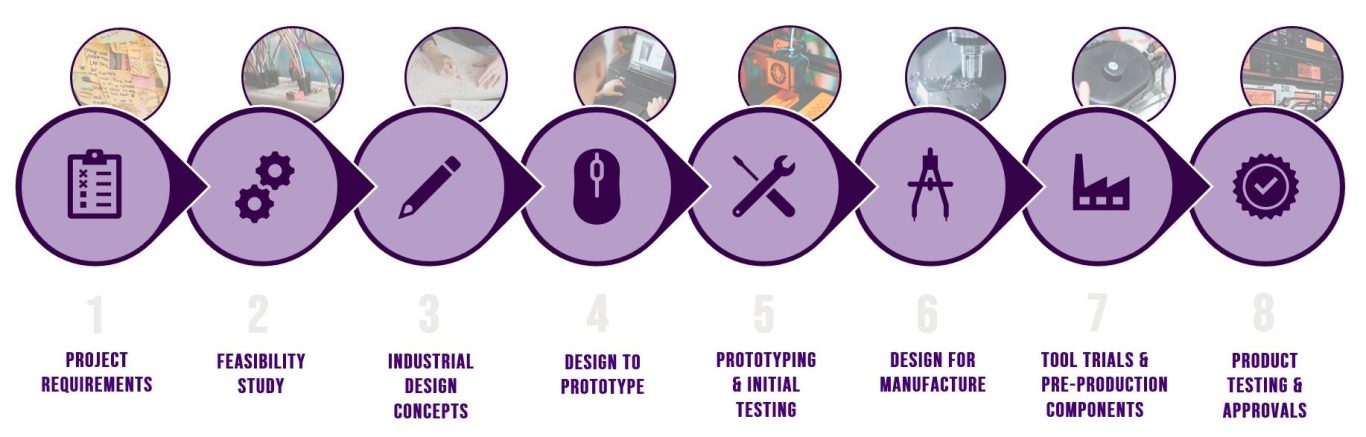
1. Project Requirements
At the start of the project it will be necessary to capture the commercial and product needs. This information gathering process will generate a design brief or Product Requirement Specification (PRS) for the team to follow. Defining project goals against parameters will focus the team's effort and set out clear objectives for success.
2. feasibility study
This phase of work validates the initial product idea and its potential. Feasibility work is different for each project, but could include a benchtop rig, space model, CAD layouts, initial calculations or a set of components laid out on a breadboard. This work will help realise the products' potential, project timings and resource required.
3. industrial design concepts
Utilising the output of the feasibility study, this creative phase considers shape, materials, textures and colours to generate something aspirational. Industrial Designers generate a selection of styling options that holistically consider the functional and branding requirements. Industrial designs will be presented as finished renders, created either by hand, creative artwork packages or 3D software. We favour a traditional process over the use of AI generated product images, this allows Mechanical Engineers to comment and plan the final path to production.
4. design to prototype
Once a styling direction has been agreed, Design Engineers will translate the renders into a 3D CAD assembly. Initial components and assemblies will be developed, working towards the generation of a physical model. Engineers will liaise with prototype manufacturers to ensure components are optimised for the model making process.
5. Prototyping & initial testing
Physical models will be assembled where any fit and functional issues will be documented. Informal testing such as Ingress Protection, interface review, size, ergonomics and ease of assembly will also take place. Depending on the accuracy and materials used for model creation, it may also be possible to undergo impact, drop and thermal analysis testing.
6. design for manufacture
Within this phase, our engineers will optimise the design ready for production manufacture. Our engineers will work through any issues from the prototyping stage and refine the design solution for the chosen manufacturing methods. It is key for our engineers to liaise with production manufacturers for the smooth transfer of the design into production.
7. tool trials & pre-production components
Our engineers travel to the final production site to approve components and assemblies. Working closely with production teams allows for rapid updates, re-run first off components, validate and update documentation. This quick turnaround process greatly speeds up time to completion. This hands-on process can significantly cut tooling set up and initial component run time.
8. product testing & approvals
Prior to full scale production, an initial batch of components and assemblies can be created for the purpose of product testing and approvals. Accelerated life testing can be undertaken to indicate any potential failure points and certify product warranties. Within this select run of products, other formal testing such as EMC, RF, impact and Ingress Protection can be undertaken. Units can also be sent away to BSI and UL for governing body approval.